
Understanding and blame

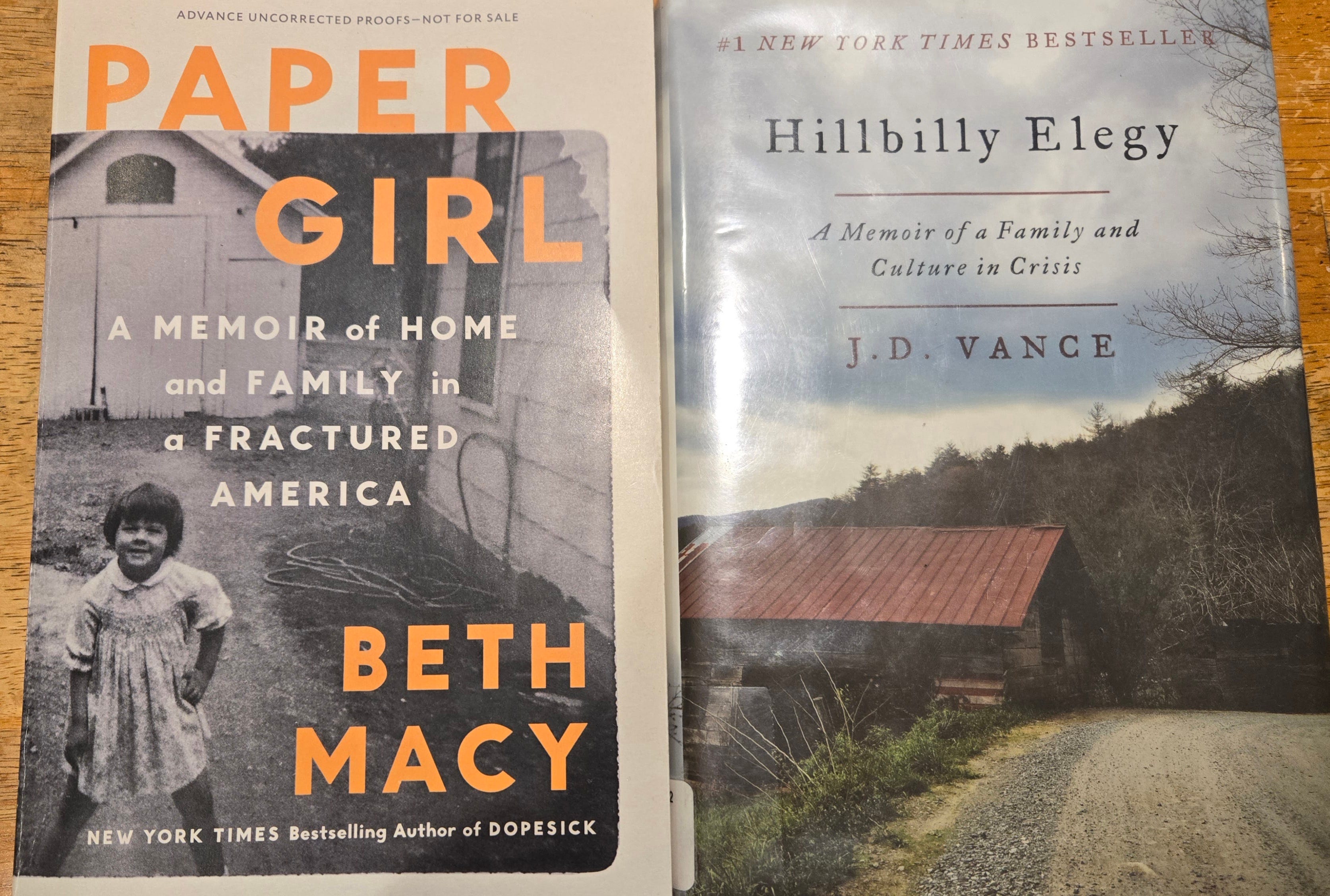
On Tuesday, we at the Ohio Capital Journal published my review of Beth Macy’s powerful new book “Paper Girl: A Memoir of Home and Family in a Fractured America.”
For the most part, I tried to avoid politics because I think a more central point of the book is that Americans need to fight their way out of their bubbles and start talking to people with whom they don’t completely agree. So I’ll address some of the politics here.
It boils down to whether we’re going to understand what has created our great and growing underclass, or whether we’re just going to blame its members for their plight, powerless as they may be. This is a question facing all comfortable people, from the oligarchs who have made that plight so much worse, to urban liberals who sneer at rural Trump voters who don’t know why vaccines are so important.
Macy spent several years making reporting trips to her native Urbana, Ohio. She grew up on the wrong side of the tracks there, managed to go to college in the 1980s, become a journalist and then a successful author. Rough as things were in her day, Macy was surprised to discover they’re far, far worse now. Trade agreements, the opioid crisis, defunded education and other billionaire-driven afflictions have hollowed out the middle class and created a large, resentful underclass.
Making the problem far worse has been the demise of a robust local newspaper.
Not only has that made the country club set unaware of its neighbors’ plight, it’s made room for a deluge of paranoid online disinformation that stifles common recognition of what’s causing the problems, much less how to solve them. Also deeply unhelpful is the fact that social-media moguls profit handsomely from algorithms that drive conflict and resentment, making the body politic ever more dysfunctional.
Explaining as it does an important part of the Trump political moment, Macy’s book has invited comparisons to (now-Vice President) JD Vance’s 2016 memoir “Hillbilly Elegy.” When it came out, many urban liberals I knew hurried to read it for insights into Trump’s America. Some believed they actually got them.
Well before Vance entered politics, I disliked the book for its lack of journalistic rigor.
Most glaring is the fact that he grew up just 24 miles from where I did till I was 15. We both were miles and miles from the nearest edge of Appalachia. But Vance spent some summers there with his grandmother and presumed that qualified him to speak for a huge region with millions of residents boasting a long, rich, diverse culture.
He also didn’t do much of what we in the biz call “reporting.” Where Macy spent years traveling back and forth to her hometown and doing repeated, often-uncomfortable interviews with old friends, new acquaintances and even family members, Vance mostly just held forth. The smattering of footnotes is so sparse (21!), it looks as if an editor hurriedly appended them in the hope of giving it heft.
What really turned me off was a passage that struck one of the falsest notes I’ve come across in a lifetime of reading. Starting on page 147, he makes a litany of un-footnoted assertions, many starting with the pronoun “we.” Among them:
“We don’t study as children, and we don’t make our kids study when we’re parents.”
“We choose not to work when we should be looking for jobs.”
“We talk to our children about responsibility, but we never walk the walk.”
After graduating high school, Vance went from the Marine Corps to Ohio State University to Yale Law School. So obviously none of those assertions vaguely applies to him despite his use of “we.”
Boiled way down, journalistic ethics means never ever writing something you know not to be true, and here was Vance doing it transparently and repeatedly. The intellectual dishonesty made me abandon the book.
But other, more thoughtful people saw the deeper flaw — that Vance was blaming the people with whom he pretended to empathise.
One such critic noted another passage that is particularly cringeworthy just now.
“Jackson [Kentucky] is undoubtedly full of the nicest people in the world [...] Its people are hardworking, except of course for the many food stamp recipients who show little interest in honest work,” it said.
In fact, a good many people who received SNAP until Vance’s boss decided to disrupt it work at places such as Walmart. Forty percent are children and elderly. All are trapped in an economy that left them behind generations ago without them getting much of a say.
Unlike Vance, Macy did the work.
She’s more from Urbana than Vance will ever be from Appalachia. But she knew she had a journalistic duty to go back and compare the reality to what she remembered.
She did the hard work of stepping out of her bubble and listening with empathy. She was shocked. She wrote what she found, and truth rings through it.
When I asked Macy about the Vance memoir, she was less scathing than I. With an addict for a mother, he had a lot to overcome and a story to tell about it. Here’s what she said:
“I thought Vance wrote a decent book about a first-generation college student. As a memoir, it worked until when he started giving these phony prescriptions. The tone changed. His story is certainly compelling, but he doesn’t give any history or any context to what happened when these rapacious, out-of-state coal companies robbed the people blind. Then here come the pill peddlers doing the exact-same thing. He’s just blaming the people instead of the corporations that did this and now of course he’s in bed with all of those corporations.”